


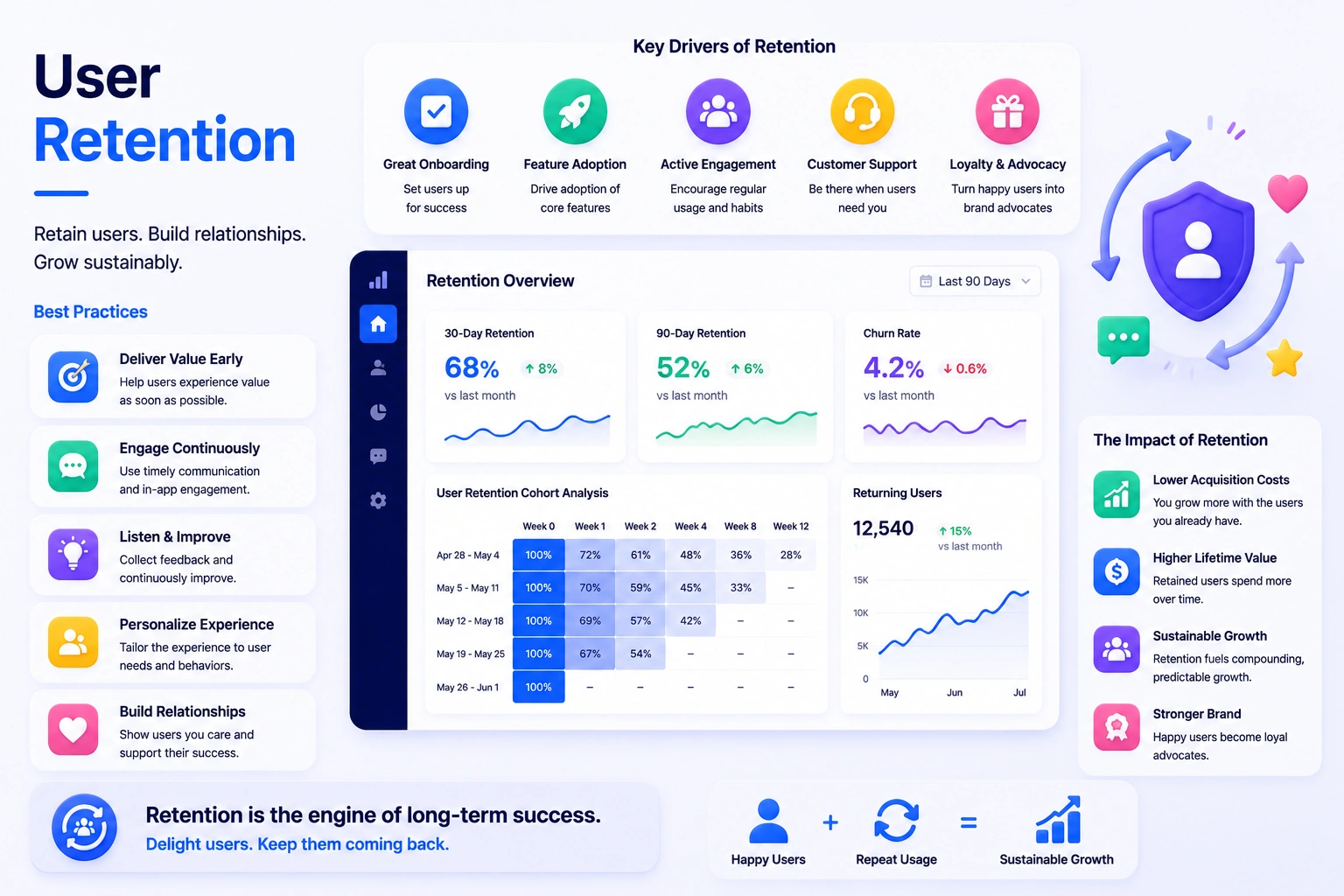
What Is User Retention?
User Retention refers to the percentage of users who continue using a product, service, website, or application over a specific period.
In simple terms, it answers a straightforward question:
Do people come back after their first visit?
A product can attract thousands of new users every week. Yet if most leave and never return, growth becomes difficult to sustain.
Retention reveals whether users find ongoing value.
Think of a local coffee shop. Getting someone to visit once is great. Getting them to return every morning is far more valuable. Digital products work much the same way.
Why User Retention Matters
Many businesses spend significant budgets attracting new customers.
That sounds exciting.
Retention is often where long-term success is built.
A product with strong retention usually experiences:
- Higher customer loyalty
- Better revenue stability
- Lower acquisition costs over time
- Stronger customer relationships
- Increased referrals and recommendations
Here’s the interesting part.
Keeping an existing user engaged is often less expensive than finding a brand-new one.
That’s why retention has become a major focus for SaaS companies, mobile apps, subscription businesses, and online platforms.
How User Retention Works
Retention measures how many users remain active after a certain period.
For example:
- 100 users sign up in January.
- 70 users are still active after one month.
- The retention rate is 70%.
The higher the percentage, the stronger the retention performance.
Companies commonly measure retention across different time periods:
Daily Retention
Tracks users who return each day.
Weekly Retention
Measures engagement across weeks.
Monthly Retention
A common metric for SaaS businesses.
Annual Retention
Often used for subscription-based services.
Each timeframe provides different insights into user behavior.
User Retention vs User Acquisition
People sometimes confuse retention with acquisition.
They are connected but serve different purposes.
User Acquisition
Focuses on attracting new users.
User Retention
Focuses on keeping existing users engaged.
Imagine pouring water into a bucket with holes.
Acquisition pours water in.
Retention patches the holes.
Without retention, growth efforts often become inefficient.
A company may continuously attract new users while losing existing ones at the same pace.
Why Users Leave
Understanding retention starts with understanding churn.
Users stop returning for many reasons:
Poor First Experience
Confusing onboarding can drive people away quickly.
Lack of Value
Users may not see enough benefit to continue.
Better Alternatives
Competitors can attract users with simpler solutions.
Product Complexity
Difficult workflows create frustration.
Weak Customer Support
Unresolved issues often lead users elsewhere.
Many retention problems begin surprisingly early, sometimes within the first few minutes of product use.
Key User Retention Metrics
Retention is measured through several important indicators.
Retention Rate
The percentage of users who remain active over a period.
Churn Rate
The percentage of users who stop using the product.
Daily Active Users (DAU)
Tracks active users each day.
Monthly Active Users (MAU)
Measures activity across a month.
Stickiness Ratio
Often calculated using DAU divided by MAU.
This reveals how frequently users return.
Lifetime Value (LTV)
Higher retention usually increases customer lifetime value.
These metrics help companies understand long-term engagement patterns.
What Influences User Retention?
Several factors affect whether users stay or leave.
Product Quality
A reliable product creates trust.
User Experience
Simple, intuitive interfaces reduce frustration.
Onboarding
Clear guidance helps users achieve success quickly.
Feature Adoption
Users who discover valuable features tend to stay longer.
Customer Support
Fast assistance builds confidence.
Product Updates
Continuous improvements keep products relevant.
Retention often reflects how well a company solves customer problems over time.
Practical Ways to Improve User Retention
Retention doesn’t happen by accident.
Successful businesses actively work on it.
Deliver Value Quickly
Users should experience benefits early.
Improve Onboarding
Guide users through important first steps.
Personalize Experiences
Relevant recommendations increase engagement.
Communicate Regularly
Helpful emails, notifications, and updates keep users informed.
Collect Feedback
User feedback often reveals hidden obstacles.
Reward Loyalty
Exclusive features or benefits encourage continued usage.
Small improvements across multiple touchpoints can create meaningful gains in retention.
User Retention in SaaS Products
Retention plays a particularly important role in SaaS businesses.
Most SaaS companies rely on recurring subscriptions.
If customers leave frequently, revenue growth becomes difficult.
That’s why SaaS teams often focus heavily on:
- Activation
- Onboarding
- Feature adoption
- Customer success
- Product education
The goal is simple.
Help customers achieve meaningful outcomes consistently.
When users succeed, retention tends to follow.
Real-World Examples of Strong Retention
Several well-known companies are famous for keeping users engaged.
Netflix
Personalized recommendations encourage continued viewing.
Spotify
Custom playlists and listening history create habit-forming experiences.
Slack
Team communication becomes deeply integrated into daily workflows.
Notion
Users build knowledge systems that become increasingly valuable over time.
Canva
Simple design tools encourage frequent use for both personal and professional projects.
These companies create ongoing value that motivates users to return repeatedly.
Common Retention Challenges
Improving retention isn’t always easy.
Many businesses face obstacles such as:
- High competition
- Changing customer expectations
- Product fatigue
- Poor onboarding experiences
- Feature overload
- Limited user engagement
Ironically, adding more features doesn’t always improve retention.
Sometimes simplifying the experience produces better results.
The Future of User Retention
Retention strategies are becoming increasingly data-driven.
Artificial intelligence can identify users who may leave before they actually do. Behavioral analytics can reveal patterns that humans might overlook.
Personalized onboarding, predictive recommendations, and automated customer success workflows are becoming common across modern digital products.
Yet one thing remains unchanged.
Users stay when products consistently help them achieve their goals.
Technology may evolve, but value remains the foundation of retention.
Final Thoughts
User Retention measures how effectively a business keeps users engaged over time. It serves as one of the strongest indicators of product value, customer satisfaction, and long-term business health.
Acquiring new users is important, but retention determines whether growth lasts. Products that help users succeed, solve meaningful problems, and create positive experiences tend to keep people coming back. Strong retention often leads to higher revenue, lower churn, and more sustainable growth.
Frequently Asked Questions (FAQs)
1. What is user retention?
User retention measures the percentage of users who continue using a product or service over a specific period.
2. Why is user retention important?
It helps businesses evaluate customer loyalty, product value, and long-term growth potential.
3. How is retention rate calculated?
Retention rate is calculated by dividing the number of retained users by the total number of users at the beginning of the period and multiplying by 100.
4. What is a good user retention rate?
The answer varies by industry, product type, and customer behavior. Higher retention generally indicates stronger user satisfaction.
5. What causes poor user retention?
Common causes include weak onboarding, poor user experience, lack of perceived value, product complexity, and strong competition.
6. How can businesses improve user retention?
Businesses can improve retention by delivering value quickly, simplifying onboarding, providing excellent support, personalizing experiences, and continuously improving their products.