


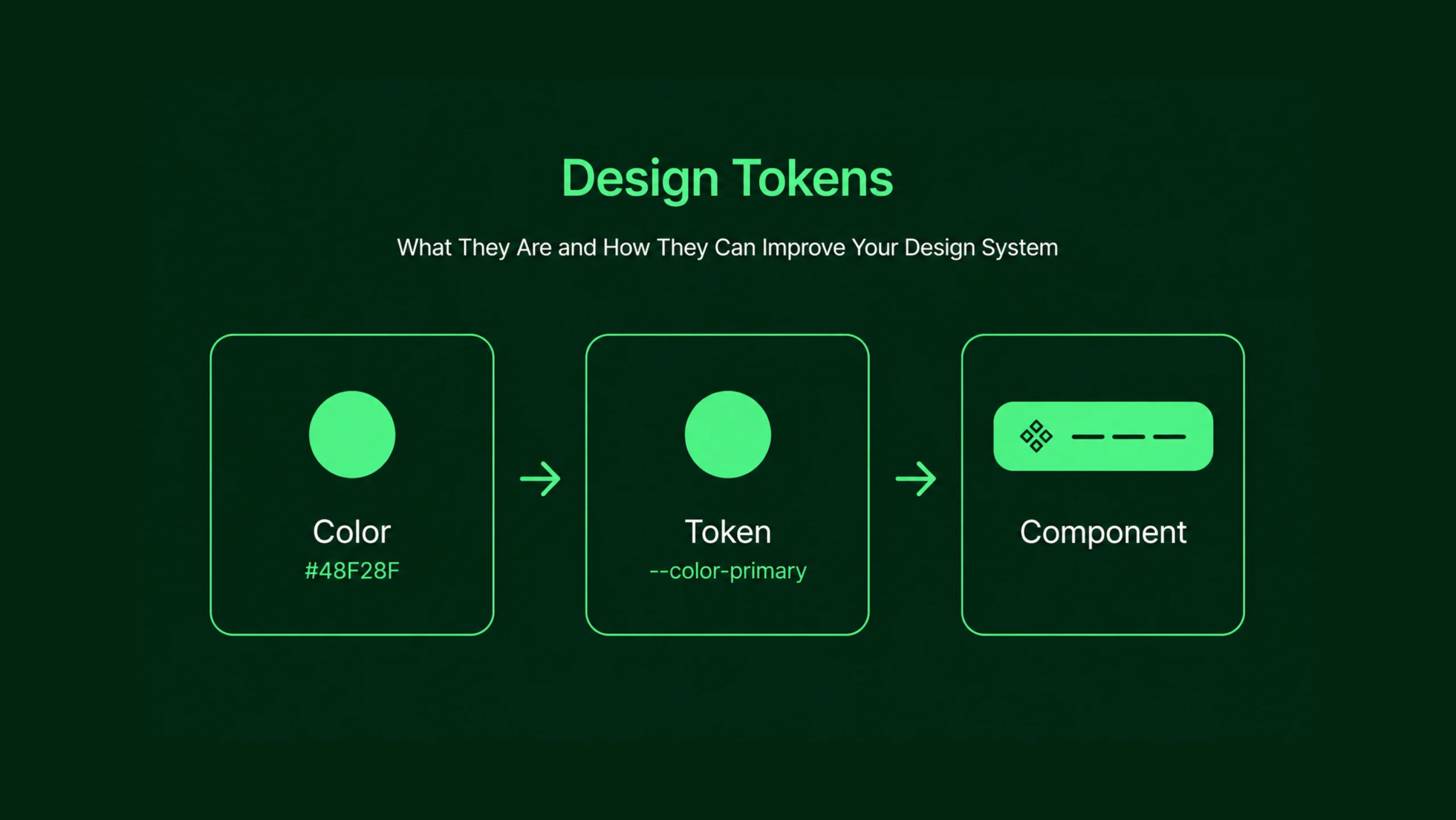
Design Token: The Building Blocks of Consistent Digital Design.
Imagine you’re designing a large SaaS platform.
The product has hundreds of screens.
Several designers are working on it.
Multiple developers are building features at the same time.
Marketing teams create landing pages.
Product managers request new modules every week.
Everything seems under control until someone decides to change the primary brand color.
Suddenly chaos appears.
One screen uses #0066FF.
Another uses #005DFF.
A third uses #0070FF.
Buttons look different. Cards feel inconsistent. Text colors vary slightly across pages.
Sound familiar?
This is exactly the kind of problem design tokens were created to solve.
They may sound technical at first, but they’re actually one of the simplest and smartest ideas in modern design systems.
Let’s break it down.
What Is a Design Token?
A design token is a named value that stores a visual design decision.
Instead of hardcoding colors, font sizes, spacing values, shadows, or border radiuses throughout a product, teams assign them meaningful names.
For example:
Instead of writing:
- #0066FF
- 16px
- 8px
A team might create:
- Primary Blue
- Font Size Medium
- Space Small
These named values become reusable references across designs and code.
Think of design tokens as labels attached to design decisions.
The label stays the same.
The underlying value can change whenever needed.
A Simple Everyday Analogy
Imagine your home has dozens of light bulbs.
One day you decide to replace every warm white bulb with cool white bulbs.
You could walk room by room and change them individually.
Or you could flip one master switch that updates everything at once.
Design tokens act like that master switch.
Instead of updating hundreds of screens manually, teams change a token value and see updates across the entire product.
Pretty convenient.
Why Design Tokens Matter
Consistency sounds boring until it’s missing.
Then everyone notices.
Users may not consciously identify small visual differences, but they definitely feel them.
A product with inconsistent spacing, colors, typography, and component styling often feels less polished.
Design tokens help create visual consistency across:
- Websites
- Mobile apps
- Dashboards
- Design systems
- Marketing pages
- Internal tools
They provide a single source of truth for visual design decisions.
The Problem Design Tokens Solve
Let’s say your company uses a blue primary button.
Without design tokens:
Designers manually apply the color.
Developers manually enter color values.
Marketing teams copy values from old files.
Over time, small differences creep in.
Now imagine changing the brand color.
The update becomes a nightmare.
Every file, component, screen, and codebase needs adjustments.
Design tokens solve this by centralizing visual values.
Change the token.
Everything connected updates automatically.
How Design Tokens Work
A design token contains two parts:
Name
The human-readable identifier.
Example:
- Color Primary
- Space Medium
- Radius Small
Value
The actual design property.
Example:
- #0066FF
- 16px
- 4px
Designers use the token name.
Systems use the underlying value.
This separation makes design systems much easier to manage.
Common Types of Design Tokens
Design tokens can represent almost any visual property.
Let’s look at the most common categories.
Color Tokens
These define brand and interface colors.
Examples:
- Primary Color
- Secondary Color
- Success Color
- Warning Color
- Error Color
- Text Primary
- Surface Background
Rather than remembering hex codes, teams use consistent token names.
Typography Tokens
Typography tokens define text styles.
Examples:
- Heading Large
- Heading Medium
- Body Large
- Body Small
- Caption
They may include:
- Font family
- Font size
- Line height
- Font weight
This keeps text consistent throughout a product.
Spacing Tokens
Spacing tokens control layout gaps and padding.
Examples:
- Space XS
- Space Small
- Space Medium
- Space Large
Instead of randomly choosing spacing values, designers use predefined options.
This creates rhythm and visual balance.
Border Radius Tokens
These control corner rounding.
Examples:
- Radius Small
- Radius Medium
- Radius Large
If a company changes its visual style from sharp corners to rounded corners, updating token values can affect the entire interface.
Shadow Tokens
Shadow tokens define elevation styles.
Examples:
- Shadow Small
- Shadow Medium
- Shadow Large
Cards, dropdowns, modals, and tooltips often rely on these values.
Motion Tokens
Modern design systems frequently include motion values.
Examples:
- Animation Duration Fast
- Animation Duration Medium
- Animation Duration Slow
Motion consistency becomes easier to maintain across interactions.
Design Tokens and Design Systems
Design tokens are often described as the foundation of a design system.
Think about a house.
Components are the walls, windows, and furniture.
Design tokens are the materials used to build them.
Buttons, cards, forms, and navigation menus all rely on token values.
Without tokens, maintaining large design systems becomes much harder.
Design Tokens vs Components
People sometimes confuse these concepts.
They work together, but they’re different.
Design Token
Stores a design value.
Example:
Primary Blue = #0066FF
Component
A reusable interface element.
Example:
Primary Button
The button uses the Primary Blue token.
The token supplies the styling.
The component provides the functionality and structure.
A Real-World Example
Let’s imagine a product team decides to refresh its brand.
The primary color changes from blue to purple.
Without tokens:
- Hundreds of design files need updates
- Developers modify many CSS files
- QA teams check every screen manually
With tokens:
Update the Primary Color token.
Done.
Every connected component inherits the new color.
Hours of work become minutes.
Design Tokens and Frontend Development
Design tokens create a bridge between design and code.
This is where things get really interesting.
Designers may create tokens inside tools like:
- Figma
- Sketch
- Adobe XD
Developers then use the same token values in:
- CSS
- SCSS
- JavaScript
- React
- Vue
- Angular
Everyone references the same source.
This reduces misunderstandings and visual inconsistencies.
Popular Tools That Support Design Tokens
Many modern tools support token workflows.
Some popular examples include:
- Figma Variables
- Tokens Studio for Figma
- Style Dictionary
- Zeroheight
- Storybook
- Specify
- Supernova
These tools help synchronize design and development systems.
Benefits of Design Tokens
The advantages become more obvious as products grow.
Better Consistency
Design decisions stay uniform across teams and platforms.
Faster Updates
Changing visual styles becomes significantly easier.
Improved Collaboration
Designers and developers work from the same language.
Easier Scaling
Growing products can maintain visual consistency without constant manual effort.
Reduced Errors
Fewer mismatched colors, font sizes, and spacing values appear throughout the product.
Common Mistakes Teams Make
Design tokens are powerful, but they’re not magic.
A few mistakes can reduce their effectiveness.
Creating Too Many Tokens
Some teams create hundreds of nearly identical tokens.
This creates confusion instead of clarity.
Poor Naming Conventions
Names should describe purpose rather than appearance.
For example:
Good:
- Primary Background
Less helpful:
- Blue 500
Purpose-based naming makes future updates easier.
Skipping Documentation
Tokens need clear documentation.
Otherwise, teams may use them inconsistently.
Treating Tokens as a One-Time Project
Design systems evolve.
Tokens need maintenance as products grow.
Design Tokens in Modern Product Design
Large companies rely heavily on tokens.
Products from major technology companies often contain thousands of screens and components.
Maintaining visual consistency manually would be nearly impossible.
Design tokens create a shared visual language that scales across products, platforms, and teams.
That’s one reason they have become a standard practice in modern product design.
Design Tokens and the Rise of AI Design
AI-powered design tools are becoming more capable every year.
They can generate layouts, suggest color palettes, and even build user interfaces.
Yet consistency remains a challenge.
Design tokens help AI-generated interfaces stay aligned with established brand guidelines.
Rather than creating random visual choices, AI systems can pull from predefined token libraries.
The result feels more cohesive and predictable.
Are Design Tokens Only for Large Companies?
Not at all.
Small startups can benefit too.
In fact, starting with tokens early can prevent many future headaches.
Even a simple design system might include:
- Five color tokens
- Five spacing tokens
- Three typography tokens
That’s enough to create consistency from day one.
As the product grows, the token library can grow alongside it.
Final Thoughts
A design token is a reusable, named design value that helps teams maintain consistency across digital products.
It acts as a central reference for colors, typography, spacing, shadows, motion, and many other visual properties.
The concept sounds technical.
The impact is surprisingly practical.
Design tokens reduce repetitive work, improve collaboration between designers and developers, and make large-scale updates far easier to manage.
Users may never know design tokens exist.
They won’t see them.
They won’t click them.
They won’t talk about them.
Yet many of the products people admire most rely heavily on them behind the scenes.
That’s often the sign of a good system.
It quietly does its job while everyone focuses on the experience.
Frequently Asked Questions (FAQs)
What is a design token?
A design token is a named value that stores a visual design property such as color, spacing, typography, shadow, or border radius for consistent use across a product.
Why are design tokens important?
Design tokens help maintain consistency, simplify updates, improve collaboration between designers and developers, and support scalable design systems.
Are design tokens only used in UI design?
No. Design tokens can be used across websites, mobile apps, design systems, marketing pages, and even multi-platform product ecosystems.
What’s the difference between a design token and a component?
A design token stores visual values, while a component is a reusable interface element that often uses those token values.
Can small teams use design tokens?
Yes. Small teams often benefit greatly from tokens because they create consistency early and reduce maintenance work later.
Which tools support design tokens?
Popular tools include Figma Variables, Tokens Studio, Style Dictionary, Supernova, Specify, Zeroheight, and Storybook.