


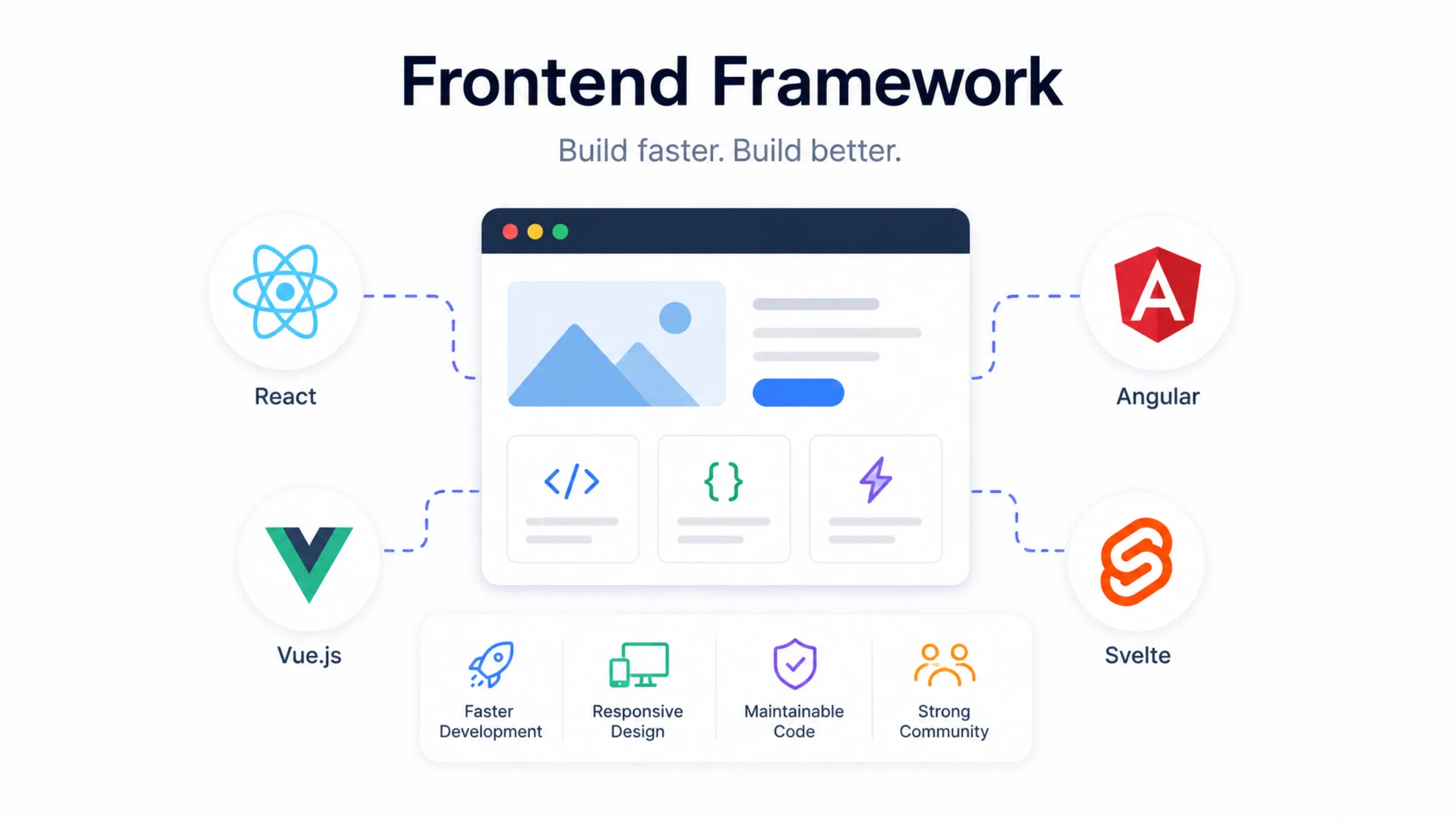
What Is a Frontend Framework?
A frontend framework is a collection of tools, reusable code structures, components, and development patterns that help developers build user interfaces for websites and web applications.
Think of it like building a house.
You could create every wall, window, door, and electrical connection from scratch. Many years ago, that’s how web development often felt. A frontend framework provides a ready-made structure so developers can focus on creating features instead of rebuilding common functionality repeatedly.
Frontend frameworks help create everything users see and interact with in a browser—buttons, forms, navigation menus, dashboards, animations, shopping carts, and much more.
Popular frameworks such as React, Angular, Vue, Svelte, and Next.js have changed how modern websites are built.
Why Frontend Frameworks Became Popular
Early websites were mostly static.
A page loaded, displayed information, and that was about it.
As web applications became more sophisticated, developers started creating online banking systems, social networks, streaming platforms, project management tools, and real-time collaboration apps. Managing thousands of interactive elements with plain JavaScript became increasingly difficult.
That’s where frontend frameworks stepped in.
They introduced organized structures that made large applications easier to build, update, and maintain.
A framework doesn’t magically make development easy. That’s a common misconception. What it does is reduce repetitive work and provide a predictable way to organize code.
How a Frontend Framework Works
At a basic level, a frontend framework helps developers connect three important pieces:
- User Interface (UI)
- Application Logic
- Data
Imagine a food delivery app.
The app needs to display restaurants, update menus, show delivery status, process orders, and react instantly when users interact with the screen.
Instead of manually updating every piece of the interface, the framework manages many of those updates automatically.
The result feels smoother for users and simpler for developers.
The Building Blocks Behind the Scenes
Most frontend frameworks include several common concepts.
Components
Components are reusable interface elements.
A button can be a component.
A navigation bar can be a component.
A product card can be a component.
Developers build components once and reuse them across an application.
State Management
State refers to data that changes while a user interacts with an application.
Examples include:
- Shopping cart contents
- User profile information
- Notification counts
- Search filters
Frameworks help keep the interface synchronized with changing data.
Routing
Routing controls navigation between pages and views.
When users move from a homepage to a product page or settings page, routing determines what content appears without requiring a full page refresh.
Data Binding
Data binding connects application data to the user interface.
When information changes, the interface updates automatically.
This may sound simple, but it saves developers a tremendous amount of manual work.
Popular Frontend Frameworks
The frontend ecosystem evolves constantly, yet several frameworks have remained industry favorites.
React
Created by Meta, React is one of the most widely used frontend technologies.
It focuses on component-based development and powers applications ranging from startups to major enterprise platforms.
Angular
Developed by Google, Angular provides a complete framework with built-in tools for routing, forms, testing, and application architecture.
Large organizations often prefer Angular for complex systems.
Vue
Vue combines simplicity with flexibility.
Many developers appreciate its gentle learning curve and clean documentation.
Svelte
Svelte approaches frontend development differently.
Instead of doing much of its work in the browser, it shifts much of that work into the build process, resulting in highly efficient applications.
Next.js
Next.js extends React and introduces features such as server-side rendering, routing, and performance improvements.
Many modern SaaS products rely on Next.js.
Framework vs Library: What’s the Difference?
People often mix these terms together.
The distinction is subtle but important.
A library provides tools that developers call when needed.
A framework provides a structure that guides how the application is built.
Imagine a toolbox versus a construction blueprint.
The toolbox contains useful equipment.
The blueprint influences the entire construction process.
React is often described as a library, while Angular is considered a full framework. In practice, many teams treat React as part of a broader framework ecosystem.
Why Developers Love Frontend Frameworks
The popularity of frontend frameworks isn’t accidental.
They solve real problems.
Faster Development
Developers can reuse components instead of rebuilding common features repeatedly.
Better Code Organization
Large projects become easier to manage when everyone follows consistent patterns.
Improved Collaboration
Teams can work on separate components without interfering with each other’s work.
Easier Maintenance
Updating a single component often updates every place where it appears.
Strong Community Support
Popular frameworks have large communities that create tutorials, plugins, tools, and documentation.
Sometimes the community becomes almost as valuable as the framework itself.
A Few Challenges Worth Mentioning
Frontend frameworks aren’t perfect.
Every technology introduces trade-offs.
Learning Curve
Frameworks introduce new concepts, syntax, and development patterns.
Beginners may feel overwhelmed initially.
Frequent Updates
The frontend ecosystem moves quickly.
A framework that feels modern today may receive significant changes within a few years.
Dependency Management
Applications often rely on numerous packages and plugins, which can increase maintenance responsibilities.
Performance Misuse
Frameworks can improve productivity, yet poor implementation can still produce slow applications.
The framework is a tool. The quality of the result still depends on how it’s used.
Frontend Frameworks and User Experience
Here’s something interesting.
Users rarely care which framework powers a website.
They care about speed, clarity, responsiveness, and reliability.
Yet the framework indirectly affects all of those factors.
A well-built frontend framework implementation can create:
- Faster page interactions
- Smooth transitions
- Better accessibility
- Consistent design systems
- Responsive layouts across devices
This is why frontend developers and UX designers increasingly collaborate closely.
Good technology and good design work hand in hand.
Frontend Frameworks in the AI Era
AI is changing frontend development in fascinating ways.
Tools such as GitHub Copilot, ChatGPT, Cursor, Claude, and various code-generation platforms can generate components, suggest fixes, create layouts, and write boilerplate code.
Developers still make the architectural decisions, but AI is helping reduce repetitive tasks.
Interestingly, frontend frameworks themselves are evolving to support AI-powered interfaces, conversational experiences, and intelligent user interactions.
A few years ago, many websites revolved around menus and buttons.
Today, chat interfaces, AI assistants, and conversational experiences are becoming common design patterns.
Frontend frameworks sit at the center of that shift.
Final Thoughts
Frontend frameworks have become a foundational part of modern web development.
They provide structure, consistency, and reusable building blocks that help teams create sophisticated digital products more efficiently.
From small personal websites to enterprise-grade platforms serving millions of users, frontend frameworks help power much of the modern internet.
The specific framework may change over time. Trends always come and go.
The underlying idea remains remarkably consistent: make interface development faster, cleaner, and easier to maintain while delivering better experiences for users.
Frequently Asked Questions (FAQs)
1. What is a frontend framework?
A frontend framework is a set of tools and reusable components that helps developers build interactive web interfaces more efficiently.
2. What are examples of frontend frameworks?
Popular examples include React, Angular, Vue, Svelte, and Next.js.
3. Why are frontend frameworks used?
They help developers build applications faster, organize code better, and manage complex user interfaces more effectively.
4. Is React a frontend framework?
React is technically a UI library, though many developers use it as part of a complete frontend framework ecosystem.
5. Which frontend framework is easiest to learn?
Many beginners find Vue approachable due to its straightforward structure and beginner-friendly documentation.
6. Do frontend frameworks improve website performance?
They can contribute to better performance when implemented correctly, though overall speed depends on application architecture and development quality.