


Have you ever opened a new app and instinctively known where to tap?
Or visited a website and immediately looked for the search bar in the top navigation?
You weren’t guessing.
You were relying on a mental model.
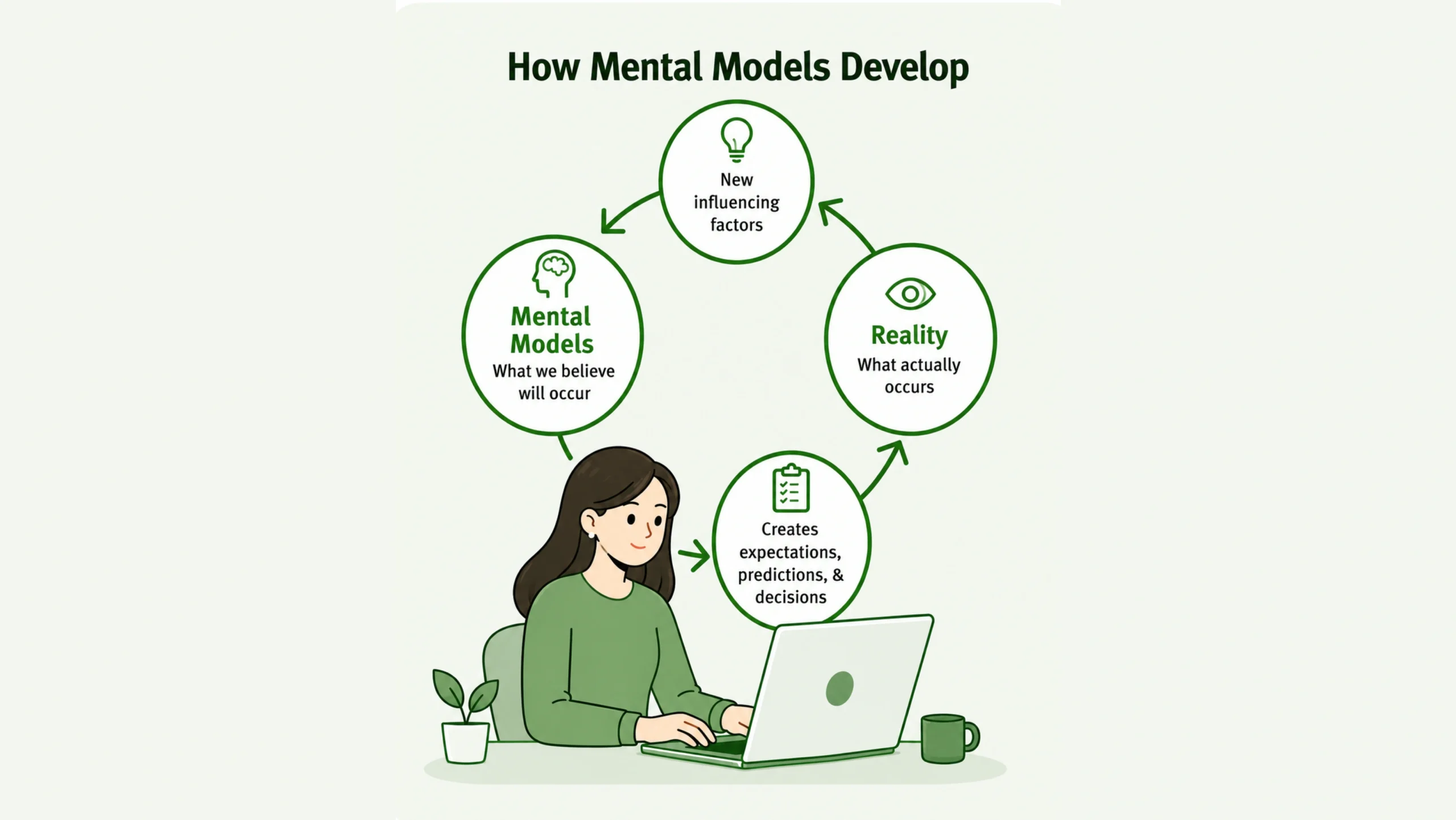
A mental model is a person’s internal understanding of how something works. It is the collection of assumptions, expectations, beliefs, and experiences people use to predict outcomes and interact with products, systems, or environments.
Mental models help people make decisions quickly.
Instead of learning everything from scratch, the brain uses previous experiences to fill in the gaps.
That’s why someone can often use a new app, website, or device without reading instructions.
Their existing mental model guides them.
Why Mental Models Matter
People rarely approach a product with a completely blank mind.
They arrive carrying expectations.
Lots of them.
A user opening an e-commerce website expects a shopping cart.
A banking customer expects to see account balances.
Someone using a messaging app expects conversations to work in familiar ways.
These expectations form mental models.
When a product behaves as expected, users feel comfortable.
When it behaves differently, confusion appears.
That’s often where usability problems begin.
Your Brain Loves Shortcuts
Here’s the thing.
Mental models are essentially shortcuts.
The human brain processes huge amounts of information every day.
Without shortcuts, even simple tasks would feel exhausting.
Imagine learning how every door works before opening one.
Thankfully, your brain already has a model.
You see a handle, push or pull, and expect a result.
Digital products work the same way.
Users bring expectations from previous experiences.
Design that respects those expectations often feels intuitive.
How Mental Models Are Created
Mental models develop over time.
They’re shaped by:
- Personal experiences
- Education
- Culture
- Technology exposure
- Social interactions
- Previous product usage
For example, decades of desktop software have taught people that a gear icon usually represents settings.
Similarly, a magnifying glass often signals search.
These associations become deeply ingrained.
Over time, they feel natural.
Mental Models in UX Design
Mental models play a major role in user experience design.
UX designers spend significant time trying to understand how users think before deciding how products should work.
The goal is simple.
Match the product’s behavior with the user’s expectations whenever possible.
When users don’t have to stop and figure things out, tasks become easier.
And easier experiences usually create happier users.
A Simple Example Everyone Understands
Think about online shopping.
Most users expect a sequence that looks something like this:
Browse products.
View product details.
Add items to a cart.
Review the cart.
Proceed to checkout.
Complete payment.
This flow has become familiar across countless websites.
If an online store suddenly forced payment before showing the cart, many users would feel confused.
The flow would conflict with their mental model.
The design might still function technically.
Yet it would feel wrong.
Mental Models Are Everywhere
Once you start looking for them, you’ll notice them constantly.
Email Applications
Users expect:
- Inbox at the top
- Sent folder available
- Search functionality
- Message threads
These expectations come from years of email usage.
Mobile Apps
Users often expect:
- Navigation at the bottom
- Profile access through an avatar
- Swipe gestures
- Pull-to-refresh interactions
These behaviors have become familiar across thousands of apps.
Streaming Platforms
Most users expect:
- Recommendations
- Continue watching sections
- Search functionality
- Watchlists
Years of exposure have shaped those expectations.
Mental Model vs Conceptual Model
These terms are often confused.
They sound similar.
Yet they describe different things.
Mental Model
A mental model exists inside the user’s mind.
It reflects what users believe about how a product works.
Conceptual Model
A conceptual model is created by designers and developers.
It represents how the system is intended to work.
The challenge for designers is closing the gap between the two.
The closer they match, the easier the product feels to use.
What Happens When Mental Models Clash?
Sometimes products challenge expectations.
That isn’t always bad.
Innovation often requires change.
The problem appears when users don’t understand the change.
Consider an unfamiliar navigation system.
The design may look impressive.
The animations may feel modern.
Yet if users can’t predict where actions will take them, frustration grows.
People rarely blame themselves.
They blame the product.
That’s why many groundbreaking products still preserve familiar patterns.
New ideas work best when users can understand them quickly.
How UX Teams Discover Mental Models
Mental models aren’t visible.
Researchers must uncover them through observation and conversation.
Several methods help.
User Interviews
Interviews reveal expectations, assumptions, and thought processes.
Participants often explain how they expect something to work.
These explanations provide valuable clues.
Contextual Inquiry
Researchers observe people performing tasks in real environments.
Watching real behavior often reveals patterns that users never mention directly.
Usability Testing
Testing highlights moments where expectations and reality collide.
Confusion often points directly to a mental model mismatch.
Surveys and Feedback
Customer comments frequently reveal expectations.
Phrases such as “I thought this button would…” often indicate a mental model issue.
Why Designing Around Mental Models Works
Products become easier to learn.
Users make fewer mistakes.
Support requests decrease.
Task completion improves.
People feel more confident.
Confidence matters.
A confident user explores.
A confused user leaves.
This is one reason successful products often feel familiar despite introducing new features.
They respect existing mental models while gradually introducing change.
Common Mental Model Mistakes
Design teams occasionally create problems without realizing it.
Designing for Themselves
Experienced teams often understand products differently than customers.
What feels obvious internally may confuse new users.
Assuming Everyone Thinks the Same Way
Different audiences have different expectations.
A first-time smartphone user may think very differently from a technology enthusiast.
Prioritizing Creativity Over Clarity
Creative interfaces can attract attention.
Yet clarity usually wins when people need to complete tasks efficiently.
Users appreciate innovation.
They appreciate simplicity even more.
Mental Models and Emerging Technology
Artificial intelligence, voice assistants, augmented reality, and wearable devices continue changing user expectations.
New mental models are forming every year.
People now expect:
- Conversational interactions
- Smart recommendations
- Predictive search
- Personalized experiences
A decade ago, many of these expectations barely existed.
Mental models evolve alongside technology.
Designers must evolve with them.
Why Mental Models Are So Important
Mental models shape how people interpret, predict, and interact with products.
Every click, swipe, search, and purchase is influenced by expectations built from previous experiences.
Products that match those expectations often feel effortless.
Products that ignore them often create friction.
For UX designers, researchers, product managers, and developers, understanding mental models is one of the most powerful ways to create experiences that feel natural, intuitive, and easy to use.
The best designs rarely force users to think harder.
They work with the way people already think.
That’s the real power of mental models.
Frequently Asked Questions (FAQs)
1. What is a mental model in UX design?
A mental model is a user’s internal understanding of how a product, system, or process should work based on previous experiences and expectations.
2. Why are mental models important?
Mental models help users predict outcomes, complete tasks faster, and interact with products more confidently.
3. How do mental models affect usability?
When a product matches user expectations, it feels easier to use. Mismatches often lead to confusion and usability issues.
4. What is the difference between a mental model and a conceptual model?
A mental model reflects the user’s understanding, while a conceptual model represents how designers intend the system to work.
5. How can designers discover user mental models?
Designers use interviews, usability testing, contextual inquiry, surveys, and observation techniques to uncover user expectations.
6. Can mental models change over time?
Yes. Mental models evolve as people gain experience with new technologies, products, and interaction patterns.