


What Is Product-Led Growth (PLG)?
Product-Led Growth, often shortened to PLG, is a business growth model where the product acts as the primary driver of customer acquisition, conversion, retention, and expansion.
Instead of relying heavily on sales calls, product demos, or lengthy negotiations, companies allow users to experience the product directly. People sign up, explore features, solve real problems, and discover value on their own.
Think of it like walking into a bakery and tasting a fresh sample before buying the whole cake. The product proves its worth first.
That’s the foundation of Product-Led Growth.
Why Product-Led Growth Became So Popular
Customer behavior has changed.
Most buyers prefer researching products independently before speaking with a sales representative. They want answers quickly and expect instant access.
Software companies noticed this shift years ago.
People didn’t want to schedule demos for every tool they wanted to try. They wanted immediate access.
As internet-based software became more common, businesses started offering free trials, freemium plans, and self-service onboarding experiences.
The result?
Products began selling themselves.
That’s where Product-Led Growth gained momentum.
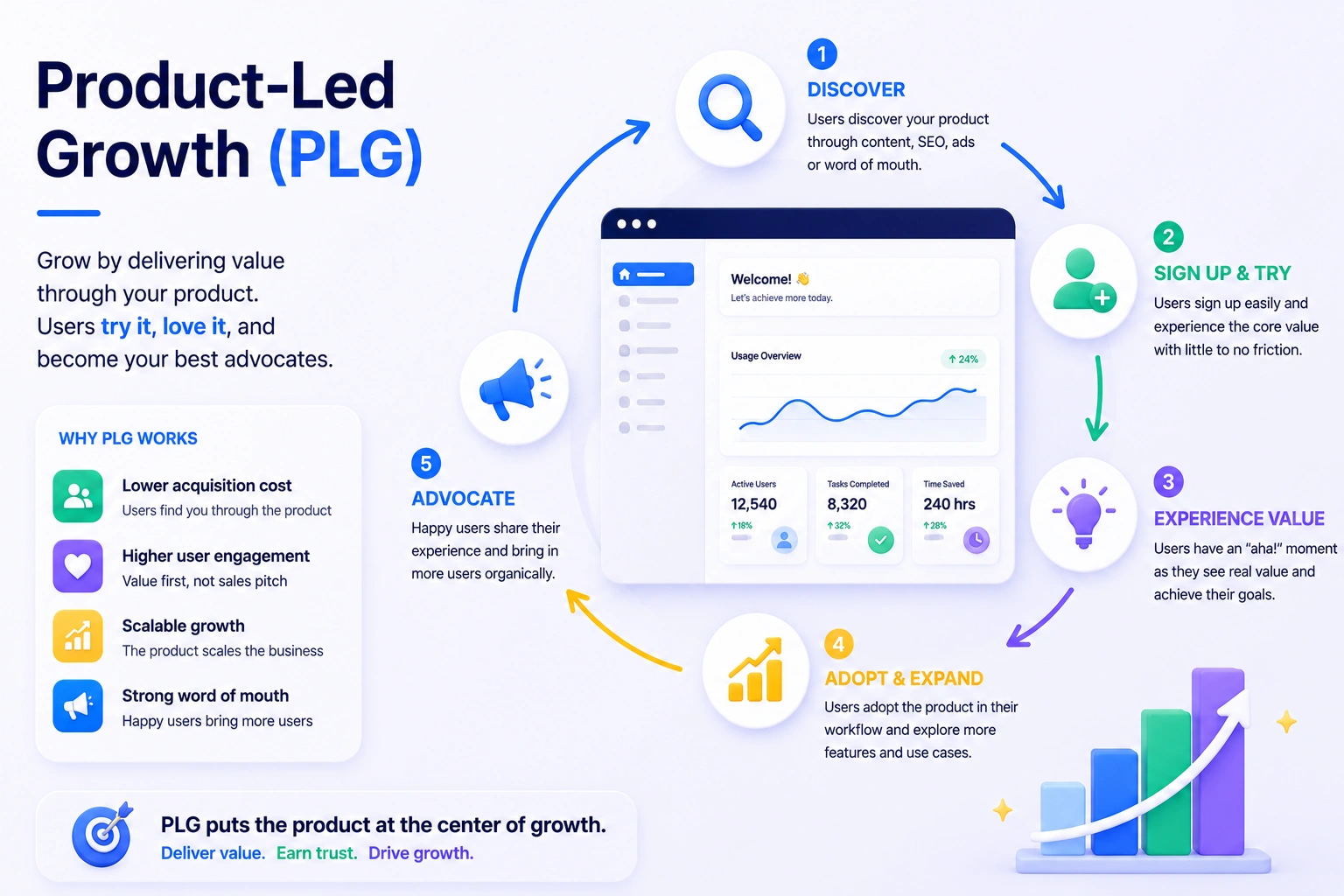
How Product-Led Growth Works
At its core, PLG follows a simple idea:
Let users experience value before asking them to pay.
A typical Product-Led Growth process looks like this:
1. User Signs Up
The customer creates an account, often without needing to contact sales.
2. User Experiences Value
The product guides users toward meaningful actions that solve a problem quickly.
3. User Becomes Engaged
As people use the product regularly, they begin integrating it into their daily workflow.
4. User Upgrades
Advanced features, higher limits, or team collaboration tools encourage users to move to paid plans.
5. User Expands Usage
Satisfied customers invite teammates, purchase additional licenses, or upgrade plans.
The product becomes both the experience and the sales channel.
The Core Principles Behind PLG
Successful Product-Led Growth companies share several common traits.
Easy Access
Users can start using the product without friction.
Fast Time-to-Value
Customers experience benefits quickly.
Self-Service Experience
People can explore features without requiring assistance from sales teams.
Continuous Improvement
Product teams constantly refine onboarding, workflows, and usability.
Data-Driven Decisions
Behavioral insights help teams understand where users succeed and where they struggle.
These principles help reduce barriers and encourage adoption.
Product-Led Growth vs Sales-Led Growth
The difference between these models is significant.
Product-Led Growth
- Product drives acquisition
- Self-service onboarding
- Free trial or freemium plans are common
- Lower initial sales involvement
- Growth comes from product adoption
Sales-Led Growth
- Sales teams drive acquisition
- Product demonstrations are common
- Contracts often involve negotiations
- Higher-touch customer interactions
- Growth depends heavily on sales processes
Neither approach is inherently better.
Many modern companies blend both models.
A product may attract users independently while sales teams support larger enterprise accounts.
Why Companies Love Product-Led Growth
PLG offers several compelling advantages.
Lower Customer Acquisition Costs
The product helps generate conversions, reducing reliance on expensive sales activities.
Faster Adoption
Users can start immediately rather than waiting for demos or approvals.
Better User Experience
People learn through direct interaction instead of presentations.
Stronger Word-of-Mouth Growth
Happy users often recommend products to colleagues and friends.
Natural Expansion
Teams frequently invite additional users after seeing value.
A single satisfied user can introduce an entire department.
Why Customers Prefer PLG
Customers benefit as well.
They can:
- Explore products freely
- Learn at their own pace
- Avoid high-pressure sales conversations
- Evaluate value before spending money
- Make informed purchasing decisions
Honestly, many people trust their own experience more than marketing messages.
PLG supports that preference.
Common Product-Led Growth Challenges
PLG sounds simple.
Building it successfully isn’t always easy.
Poor Onboarding
Users may leave if they don’t understand how to get started.
Delayed Value
If benefits aren’t visible quickly, engagement drops.
Weak Upgrade Paths
Customers need clear reasons to move from free to paid plans.
Product Complexity
Complicated interfaces create friction and reduce adoption.
Retention Problems
Acquiring users is only part of the equation. Keeping them engaged matters just as much.
Many companies discover that product design and user experience become growth functions in a PLG model.
Real-World Product-Led Growth Examples
Several well-known companies have embraced Product-Led Growth.
Slack
Users can create workspaces and invite teammates without speaking to sales.
Dropbox
Free storage encourages adoption before upgrades become necessary.
Canva
Users can create designs immediately and later purchase premium features.
Zoom
Free meetings help users experience value before upgrading.
Notion
Individuals often start alone before bringing entire teams onto the platform.
Each company allows users to experience benefits firsthand.
Key Metrics Used in Product-Led Growth
PLG companies monitor several important metrics.
Activation Rate
The percentage of users who reach a meaningful success milestone.
Product Adoption
Measures how frequently features are used.
Conversion Rate
Tracks how many users become paying customers.
Retention Rate
Shows how many users continue using the product.
Churn Rate
Measures how many customers stop using the service.
Expansion Revenue
Tracks revenue generated through upgrades and additional users.
These metrics reveal how effectively the product drives growth.
Building a Strong Product-Led Growth Strategy
Creating a successful PLG model requires careful planning.
Focus on User Value
Users should solve a real problem quickly.
Simplify Onboarding
Reduce confusion and help people get started fast.
Measure User Behavior
Analytics, heatmaps, and session recordings provide useful insights.
Encourage Collaboration
Many PLG products grow through team invitations and shared workflows.
Continuously Improve
User expectations change over time. Products must evolve alongside them.
Growth becomes a continuous process rather than a one-time initiative.
The Future of Product-Led Growth
PLG continues gaining momentum across SaaS, AI platforms, productivity software, and collaboration tools.
Artificial intelligence is making onboarding more personalized. Products can now guide users based on behavior, goals, and usage patterns.
Meanwhile, customers continue expecting immediate access and self-service experiences.
That trend isn’t slowing down.
Products that deliver value quickly and clearly will continue attracting attention.
Final Thoughts
Product-Led Growth is a strategy where the product becomes the primary engine for acquiring, converting, and retaining customers. By allowing users to experience value before making purchasing decisions, companies can build trust, reduce sales friction, and create sustainable growth.
For modern SaaS businesses, PLG has become one of the most influential growth models. When supported by strong onboarding, intuitive design, and meaningful customer outcomes, the product itself becomes the strongest marketing and sales asset a company can have.
Frequently Asked Questions (FAQs)
1. What is Product-Led Growth (PLG)?
Product-Led Growth is a business strategy where the product drives customer acquisition, activation, retention, and revenue growth.
2. How does Product-Led Growth work?
Users gain direct access to a product, experience value quickly, and upgrade as their needs grow.
3. What is the difference between PLG and sales-led growth?
PLG relies on the product to attract and convert users, while sales-led growth depends more heavily on sales teams and direct outreach.
4. Which companies use Product-Led Growth?
Popular examples include Slack, Dropbox, Canva, Zoom, and Notion.
5. Why is Product-Led Growth important for SaaS companies?
It helps reduce acquisition costs, improves adoption, and allows users to experience value before purchasing.
6. What metrics are commonly used in Product-Led Growth?
Activation rate, conversion rate, retention rate, churn rate, feature adoption, and expansion revenue are among the most important PLG metrics.